Conventional Tower Hoist vs Multi Functional Tower Hoist: Which One is Right for Your Project?

"Conventional Tower Hoist or Multi Functional Tower Hoist?" — this is one of the most common questions LIFTILE engineers are asked by builders evaluating their first or fifth construction hoist. Both machines look broadly similar from the outside: a vertical steel mast, a lifting platform, a drive unit and a control panel. Inside, however, they are designed around very different priorities.
This comparison guide walks through both machines side by side. By the end, you will have a clear, project-driven answer about which one fits your site best — and you will understand the trade-offs well enough to defend the decision in any technical review.
Quick Overview of Both Hoists
Conventional Tower Hoist
A conventional tower hoist is a single-purpose, single-material lifting machine. It is built around a fixed bucket or tray, optimised for one specific load type — most commonly aggregate, sand, concrete, or bagged material in fixed sizes. The geometry, drive ratio and platform design are tuned for that one material, which makes it extremely efficient when used exactly as intended.
Multi Functional Tower Hoist
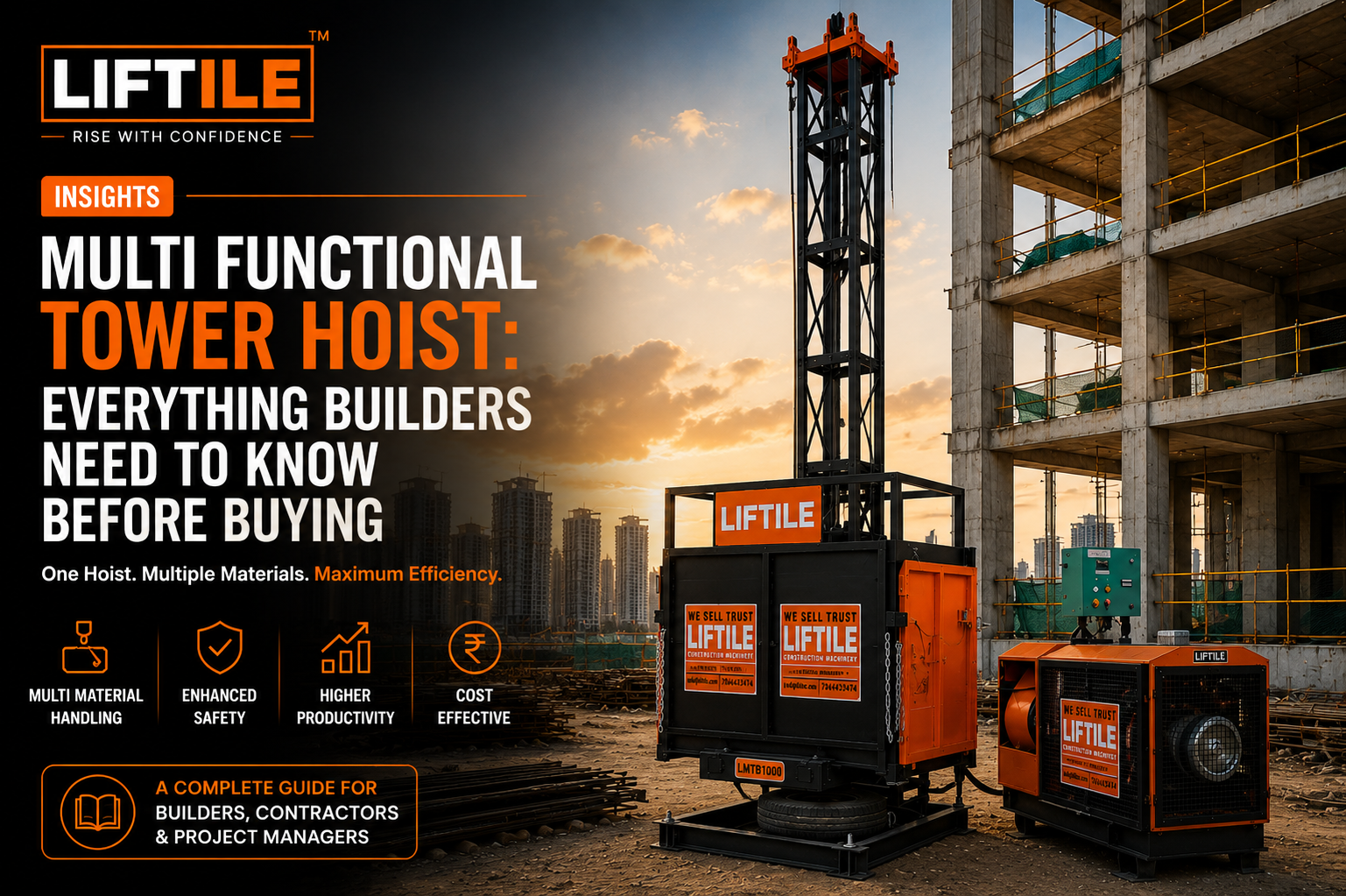
A multi functional tower hoist is a flexible platform that accepts swappable attachments — cement trolleys, brick cages, drum holders, palletised loaders. The same machine handles bagged, bulk, palletised and small mechanical components simply by changing the attachment.
In short: the conventional hoist is a specialist; the multi functional hoist is a generalist. Both have their place.
Side-by-Side Comparison Table
| Feature | Conventional Tower Hoist | Multi Functional Tower Hoist |
|---|---|---|
| Load Types Handled | Single material (e.g. aggregate) | Bagged, bulk, palletised, mixed |
| Platform / Attachment | Fixed bucket or tray | Interchangeable trolleys & cages |
| Typical Capacity | 500 – 1000 kg | 500 – 1500 kg |
| Typical Speed | 25 – 40 m/min | 25 – 40 m/min |
| Lifting Height | Up to 60 – 90 m | Up to 90 – 120 m |
| Best For | Concrete & aggregate-heavy projects | Multi-phase residential, commercial |
| Adaptability | Low (purpose-built) | High (whole project lifecycle) |
| Capital Cost | Lower | Slightly higher |
| Lifecycle Versatility | Limited to single phase | Useful from foundation to finishing |
| Resale Value | Project-specific | Strong — usable on next project too |
| Ideal Project Duration | Short to medium | Medium to long |
The table above is a useful starting point, but the right answer for your project depends on a few specific questions. Let's go deeper.
Conventional Tower Hoist — Strengths & Limitations
Strengths
- Purpose-built efficiency — when the load profile is consistent and the project is concrete- or aggregate-heavy, a conventional hoist delivers excellent productivity per shift.
- Simpler operation — fewer attachments mean less training time and lower operator error.
- Lower capital outlay — typically the entry-level option for builders with constrained project budgets.
- Robust and proven — the design is mature, with decades of field-proven performance.
Limitations
- Single-material design — if your project moves from concrete to brick to finishing, the same hoist becomes underutilised.
- Lower resale flexibility — buyers in the second-hand market often prefer multi functional units for their broader application.
- Limited height variants — the typical product range tops out around 60-90 m of tied height, which is fine for low-rise but limiting for taller towers.
Multi Functional Tower Hoist — Strengths & Limitations
Strengths
- Adaptable across phases — one machine handles cement during structural work, brick during masonry, tiles during finishing.
- Higher project utilisation — a multi functional hoist tends to be in use for more of the project calendar than a single-purpose unit.
- Better resale — broader buyer market on the second-hand circuit.
- Longer height range — typically available with tied-height ratings up to 90-120 m, making it suitable for taller towers.
Limitations
- Slightly higher capital cost — the flexibility of interchangeable attachments adds engineering and material cost.
- More training — operators need to understand the safe handling rules for each attachment type.
- Marginally more maintenance — multiple attachment interfaces require periodic inspection.
Application-Based Recommendations
Project Type 1 — Single-phase, concrete-heavy work (small commercial, basement, infrastructure)
Recommendation: Conventional Tower Hoist. When the entire load profile is one material moved repetitively, the conventional hoist's purpose-built design is the most economical and efficient choice.
Project Type 2 — Residential tower, G+10 and above, multi-phase scope
Recommendation: Multi Functional Tower Hoist. The lifecycle from foundation to handover involves cement, sand, brick, tile, MEP and finishing materials. A multi functional unit covers all phases without changing machines.
Project Type 3 — Mixed-use commercial / mall / hotel
Recommendation: Multi Functional Tower Hoist — sometimes paired with a parallel passenger cum material hoist for crew movement.
Project Type 4 — Repetitive infrastructure work (bridges, viaducts, treatment plants)
Recommendation: Conventional Tower Hoist if the load profile is uniform; multi functional if site logistics are variable.
Project Type 5 — Renovation, retrofit or fit-out
Recommendation: Multi Functional Tower Hoist — its flexibility shines when the load profile is unpredictable.
Cost & Value Considerations
Capital cost is only one dimension of total ownership cost. The full picture includes:
- Utilisation rate — how many days per year is the machine actually lifting?
- Reusability across projects — can the same machine serve your next project?
- Resale value — what does the second-hand market pay for this configuration in five years?
- Downtime cost — every day the hoist is down, the whole site loses productivity.
A conventional hoist may look 15-20% cheaper at the quotation stage, but on a multi-phase, multi-year project, the multi functional unit often delivers better total economics — because it is used for more of the project calendar and retains stronger resale value.
Practical Tip: Ask your shortlisted manufacturer to model a five-year ownership scenario for both options, including utilisation, expected service costs and an honest resale assumption. The number that matters is not the invoice price — it is the total cost per ton-metre lifted across the asset's life.
Maintenance & Operating Differences
| Maintenance Item | Conventional | Multi Functional |
|---|---|---|
| Wire rope inspection | Same | Same |
| Gearbox lubrication | Same | Same |
| Brake system test | Same | Same |
| Attachment inspection | Bucket only | All attachments per cycle |
| Operator training | Standard | Slightly extended |
| Mast tie checks | Same | Same |
In practical terms, the day-to-day maintenance load for both machines is very similar. The multi functional unit adds modest extra checks for the attachment interface, but these are quick visual inspections that fit inside the existing pre-shift routine.
Buying Recommendations
- Map your project's load profile by phase — list every material type and the peak daily volume.
- Estimate total project duration — short projects favour conventional; longer projects favour multi functional.
- Plan two projects ahead — if your next two pipeline projects need flexible lifting, choose multi functional now.
- Insist on branded internals — Bonfiglioli gearbox, ABB or Schneider electricals, Usha Martin rope, regardless of which type you buy.
- Request a comparison quotation — a transparent manufacturer will gladly quote both options with all line items broken out.
- Verify after-sales support in your geography — a great machine without local service is an expensive paperweight.
Frequently Asked Questions
Q1. Can the same manufacturer offer both options?
Yes — every serious construction-hoist manufacturer offers both. LIFTILE, for instance, has conventional and multi functional ranges sharing common safety, electrical and structural design philosophies.
Q2. Can a conventional hoist be upgraded to multi functional later?
Partially. Some load tables and attachments can be retrofitted, but the drive ratio, platform structure and control logic are tuned at manufacture. A clean swap is usually more economical than a retrofit.
Q3. Does the safety system differ?
The core safety systems — overspeed brake, slack rope detection, limit switches, overload sensor, emergency stop — are identical. Both machines must meet the same IS 3696 / EN 12158 reference standards.
Q4. Which is faster?
At equal capacity and motor rating, both machines run at the same lifting speed. The productivity difference comes from how well the machine fits the load type, not from raw speed.
Q5. Which is right for a builder buying their first hoist?
For most multi-phase residential or commercial projects, a multi functional tower hoist is the safer first purchase — it covers all phases and retains better resale value if your needs change.
Conclusion
There is no universally "better" choice between a conventional tower hoist and a multi functional tower hoist. Each is the right answer for the right project. Conventional units excel when the load profile is consistent and the project is concentrated; multi functional units excel when the work spans phases, the project is taller, and flexibility has measurable value.
The most important decision is not the type of hoist — it is the quality of the hoist and the manufacturer behind it. A poorly built multi functional unit is no better than a poorly built conventional one. Choose a manufacturer who engineers with discipline, builds with branded components and supports with care — and either configuration will serve you well.
Need Help Choosing the Right Construction Equipment?
Our engineering team is ready to help you select the right solution for your project.