Multi Functional Tower Hoist: Everything Builders Need to Know Before Buying

The Multi Functional Tower Hoist is the workhorse of modern construction sites in India. Compact enough to fit a narrow plot, powerful enough to lift cement, bricks, steel and even small concrete buckets, and flexible enough to adapt as the project grows — it has become the default vertical-transport solution for a huge range of builders, contractors and developers.
But not all tower hoists are built the same. The visible structure may look similar across manufacturers, but the engineering inside — the gearbox, the motor, the wire rope, the safety systems, the powder coating — can vary dramatically. This guide walks through what a multi functional tower hoist actually is, how it is used on real sites, what to verify before buying one, and how to compare options confidently.
What is a Multi Functional Tower Hoist?
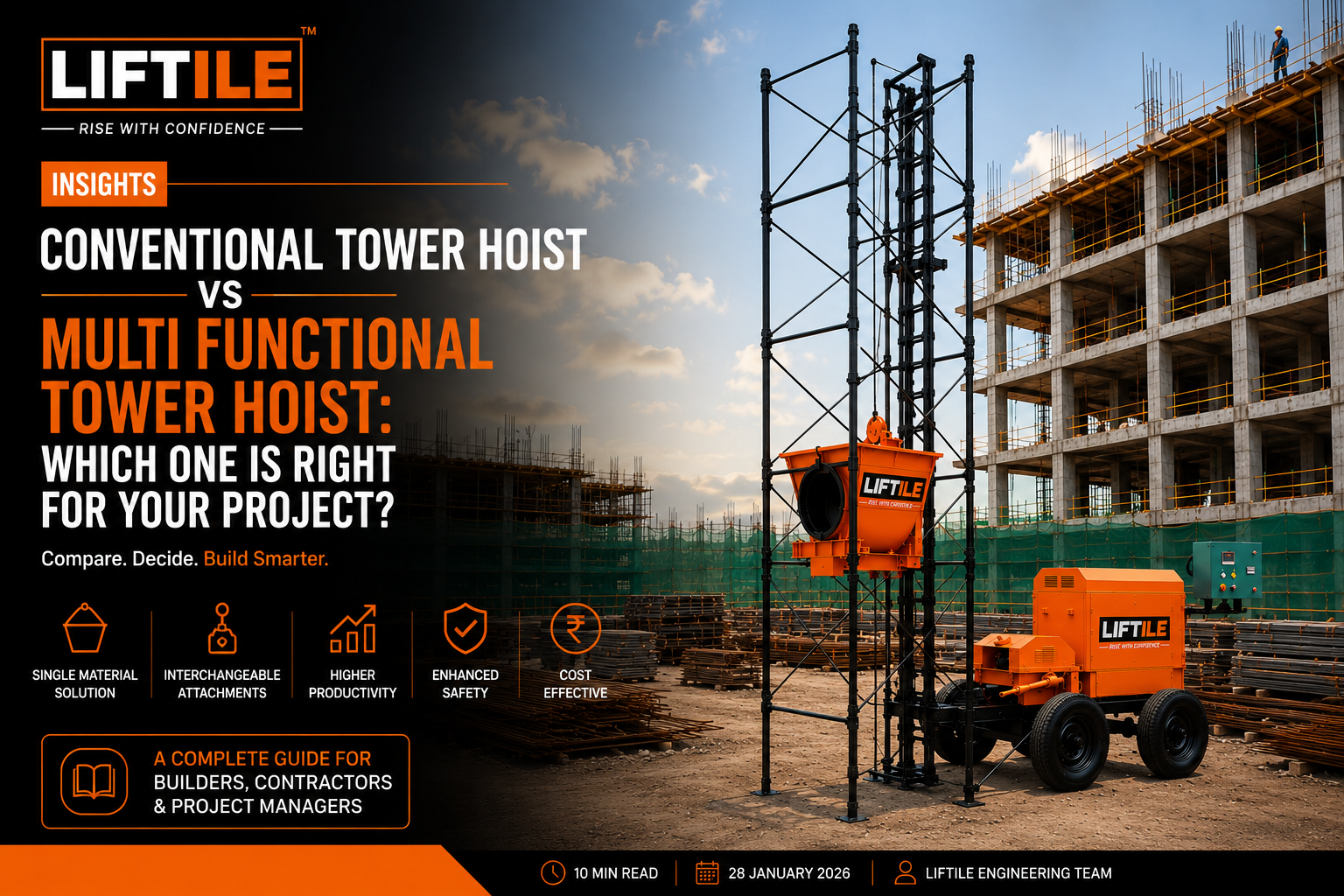
A multi functional tower hoist is a vertical-lift machine designed to move multiple types of construction materials — cement bags, bricks, sand, aggregate, steel, formwork and small concrete loads — using a single, flexible platform. Unlike a single-bucket tower hoist that is purpose-built for one material, a multi functional unit accepts trolleys, baskets, drums and pallets, making it useful from foundation to finishing.
It is called tower because its structural mast is a vertical steel tower assembled from standardised sections. It is called multi functional because the same machine handles bagged, bulk and palletised materials with simple attachment changes.
Common Applications on Indian Construction Sites
- Residential builders — moving cement, sand, brick and steel from ground stock to upper floors.
- Commercial projects — facade panels, drywall sheets, mechanical-electrical-plumbing (MEP) trolleys.
- Infrastructure contractors — lifting precast components, formwork shutters and inspection gear up bridge piers and pylons.
- Industrial sites — boiler shells, pipework and structural members during plant erection.
- Renovation projects — quick deployment for retrofit jobs where a full passenger hoist is not justified.
Inside the Machine — Key Components Explained
Drum & Wire Rope
A precision-machined drum spools the lifting wire rope. Quality manufacturers use Usha Martin or equivalent ungalvanized steel rope with 6×36 or 6×37 construction for the right balance of strength and flexibility.
Drive Motor
A foot-mounted or flange-mounted three-phase induction motor — typically 5 HP, 7.5 HP, 10 HP or higher — provides the lifting torque. Class F insulation and IP55 protection are common specifications.
Worm Reduction Gearbox
Heavy-duty worm reducers from Bonfiglioli, Elecon or Watt Drive transmit torque with self-locking behaviour, which acts as an additional safety layer in the event of brake failure.
Mast Sections
Welded box-section mast modules with diagonal bracing form the vertical structural backbone. The mast is anchored to the building or to an independent tie-frame at calculated intervals.
Loading Platform
A reinforced steel platform with safety rails, anti-skid checker-plate flooring and material restraints carries the load. Optional attachments include cement-bag trolleys, brick cages and aggregate skips.
Control Panel
ABB or Schneider contactors, phase-failure protection, overload relay and an isolation switch are mounted in an industrial enclosure at ground level. A push-button pendant gives the operator full control.
Safety Brake
A mechanical centrifugal or rack-engaged safety brake engages instantly if the platform descends faster than its rated speed.
Standard Specifications Builders Look For
| Specification | Common Range |
|---|---|
| Lifting Capacity | 500 kg – 1500 kg |
| Lifting Speed | 25–40 m/min |
| Lifting Height (tied) | Up to 90–120 m |
| Motor Rating | 5 HP – 12.5 HP |
| Power Supply | 415 V, 3-phase, 50 Hz |
| Mast Section Length | 1.5 m or 2 m standard |
| Wire Rope Diameter | 10 mm – 13 mm |
| Compliance | IS 3696 / EN 12158 reference |
These are typical figures across the Indian market. A reputable manufacturer will customise the configuration to your project's specific load, height and shift-duty cycle.
Why "Multi Functional" Matters
A purpose-built single-material hoist is fine if your site only needs to move one thing for one phase. But real projects don't behave that way. The same plot needs to lift cement during structural work, brick during masonry, tiles during finishing and MEP components during commissioning.
A multi functional tower hoist gives you the flexibility to swap attachments — cement trolley, brick cage, palletised loader — without changing the machine. That means one capital purchase serves the whole project lifecycle, and the same machine can be redeployed to your next project with minimal modification.
Practical Tip: On a typical residential tower, a single 1000 kg multi functional tower hoist can replace two specialised hoists and free up your crane for structural lifts — a 30-40% reduction in vertical-transport capital expenditure.
Safety Systems You Should Insist On
- Overspeed Safety Brake — clamps the platform if descent exceeds the safe rate.
- Slack-Rope Detection — automatically de-energises the motor if the wire rope goes slack.
- Upper & Lower Limit Switches — prevent the platform from over-travelling at either end.
- Overload Sensor — disables operation if the load exceeds the rated capacity.
- Emergency Stop & Phase Failure Relay — instant safe shutdown for any abnormal electrical condition.
- Anti-Drift Brake — keeps the platform stationary at landing during loading and unloading.
- Mast Bolt Integrity Checks — built into the daily and monthly maintenance schedule.
Buying Considerations & Common Mistakes
1. Don't shop on price alone
The cheapest tower hoist on the market almost always uses unbranded gearboxes, low-grade rope and basic electricals. Three breakdowns in a six-month season will erase any upfront saving.
2. Verify the rated load matches your real loads
Many builders quote "1000 kg capacity" without checking whether their actual cement-bag trolleys weigh 850 kg + 150 kg of structure. Always size the hoist 15-20% above your maximum operational load.
3. Ask about powder coating
Premium manufacturers apply a phosphating + epoxy primer + polyester top-coat system, giving the mast 5-7 years of weather resistance. Cheap units use a single coat of synthetic enamel that peels in the first monsoon.
4. Check spare parts availability
A 48-hour spare-parts SLA is normal for premium suppliers. Anything beyond a week is a red flag.
5. Request a service map
Before placing the order, ask the manufacturer to show their service-engineer locations in your project geography. A great machine without a nearby service team is a liability.
Maintenance & Lifecycle Tips
- Lubricate the wire rope every two weeks with the manufacturer-recommended grease.
- Inspect rope strands for broken wires monthly — replace at the first sign of fatigue.
- Re-torque mast tie bolts after every 5 sections added.
- Test the safety brake at least once a month using the documented drop-test procedure.
- Maintain a daily log of working hours, loads carried and any abnormal noise or vibration.
A multi functional tower hoist that is treated as an asset — not a disposable site tool — will easily deliver 10-15 years of service across multiple projects.
Frequently Asked Questions
Q1. Can a multi functional tower hoist carry passengers?
No. Tower hoists are material-only by certification. To move workers vertically, use a passenger cum material hoist that is specifically designed and certified for personnel transport.
Q2. How much site footprint does a tower hoist need?
The base plate typically requires a 2.0 m × 2.0 m clear pad, with a 1 m clearance corridor for loading. Total site footprint is roughly 6 m² including the loading apron.
Q3. What is the difference between a conventional and multi functional tower hoist?
A conventional unit usually has a fixed bucket and is purpose-built for one material — typically aggregate or concrete. A multi functional unit takes interchangeable attachments and can handle bagged, palletised and bulk loads through the same platform.
Q4. How fast can the mast be extended?
A trained two-man crew can add 6 m of mast (3 sections of 2 m) in roughly 4-6 hours, including tie installation and limit-switch repositioning.
Q5. What is the typical price range?
Prices vary based on capacity, lifting height, drive configuration and component brands. A 1000 kg multi functional tower hoist typically falls in a wide market band; request a formal written quotation from your shortlisted manufacturers — it is the only honest way to compare.
Conclusion
A multi functional tower hoist is one of the most cost-effective machines you can deploy on a construction project. It moves more material per shift than manual hoisting, costs a fraction of a tower crane to operate, and adapts across every phase from foundation to handover.
But its real value depends on what is inside it — and on the manufacturer who stands behind it. Pick a partner who builds with branded components, inspects every machine before dispatch, and takes service obligations seriously, and your tower hoist will earn its keep on this project and the next.
Need Help Choosing the Right Construction Equipment?
Our engineering team is ready to help you select the right solution for your project.